

When I first heard about managed care pharmacy, I’ll admit – I didn’t fully understand what it was. Like many pharmacy students, I thought, “Isn’t that just deals with insurance denials and cutting costs?”
But as I learned more, I realized this field offers meaningful clinical work, broad healthcare impact, and exciting career opportunities. Unfortunately, it’s also one of the most misunderstood areas in our profession.
In this post, I’ll to walk you through some of the top misconceptions about managed care pharmacy. Whether you’re a student, resident, or practicing pharmacist, I hope this gives you insight into the purpose, potential, and meaningful contributions of this fascinating career path.
What is Managed Care Pharmacy?
If you are unfamiliar with the basics of managed care pharmacy, I recommend checking out my earlier blog post: Unpacking the Mystery: What Are the Key Concepts In Managed Care Pharmacy?
Misconception #1: “It’s Only About Cutting Costs”
Why do we even care about cost in healthcare? To be blunt: resources are limited. Healthcare budgets – for insurance plans, government programs (like Medicare or Medicaid), employers, and patients – simply can’t cover everything. It would be ideal. But it’s not the reality.
Balancing clinical outcomes with cost ensures that healthcare systems remain financially sustainable in the long term, allowing them to serve large populations. By considering cost alongside evidence and outcomes, we can focus on therapies that deliver real, meaningful benefits – not just the newest or most expensive options.
In short, cost control isn’t about being cheap or cutting corners; it’s about ensuring fair, equitable, and responsible use of healthcare resources so we can help as many patients as possible, both now and in the future.
So, how does this tie back to managed care pharmacy?
Yes, managed care involves controlling costs – but not in the way most people imagine. It’s not about denying care or picking the cheapest option. It’s about making thoughtful, evidence-based decisions that deliver value across a patient population.

In this role, managed care pharmacists:
- Evaluate drug therapies based on clinical trial data, safety profiles, real-world evidence, clinical guidelines, and comparative effectiveness
- Recommend coverage of higher-cost medications if data show they improve clinical outcomes or help prevent costly complications later
- Collaborate closely with medical directors, prescribers, specialists, data analytics, actuaries, and health economists to ensure policies make clinical and financial sense
- Design prior authorization (PA) criteria to ensure high-cost or high-risk medications (e.g., those frequently subjected to misuse, with black box warnings, or special population concerns) are used appropriately and aligned with evidence-based standards
Misconception #2: “It’s a Non-Clinical Desk Job”
Sure, you are not mixing IV bags or verifying prescriptions – but the clinical thinking involved in managed care is deep, constant, and applied at a system level rather than by patient.
Managed care pharmacists routinely:
- Review clinical trial data and publications to assess drug effectiveness and safety
- Develop evidence-based policies that guide appropriate medication use
- Participate in Pharmacy & Therapeutics (P&T) committee meetings to discuss clinical merits of drug under review
- Collaborate with specialists, nurses, and medical directors to align drug coverage policies with current treatment guideline
- Analyze prescribing patterns and patient outcomes to improve overall care quality

In fact, many pharmacists say they use more clinical knowledge in managed care because they work across a wide range of disease states and need to understand both emerging evidence and practical healthcare delivery.
Misconception #3: “It’s Only for People Who Don’t Like Patient Care”
There’s a common misunderstanding that pharmacists in managed care are “stepping away” from patient care – that they prefer paperwork, policies, or analytics over making a clinical difference. But this couldn’t be further from the truth.
In reality, many managed care pharmacists are deeply motivated by improving patient outcomes – they simply approach it from a population health and systems-level perspective. Instead of helping one patient at a time, they help shape policies and programs that impact hundreds of thousands of patients across a health plan, state program, or national system.
Here’s how that plays out in the managed care setting:
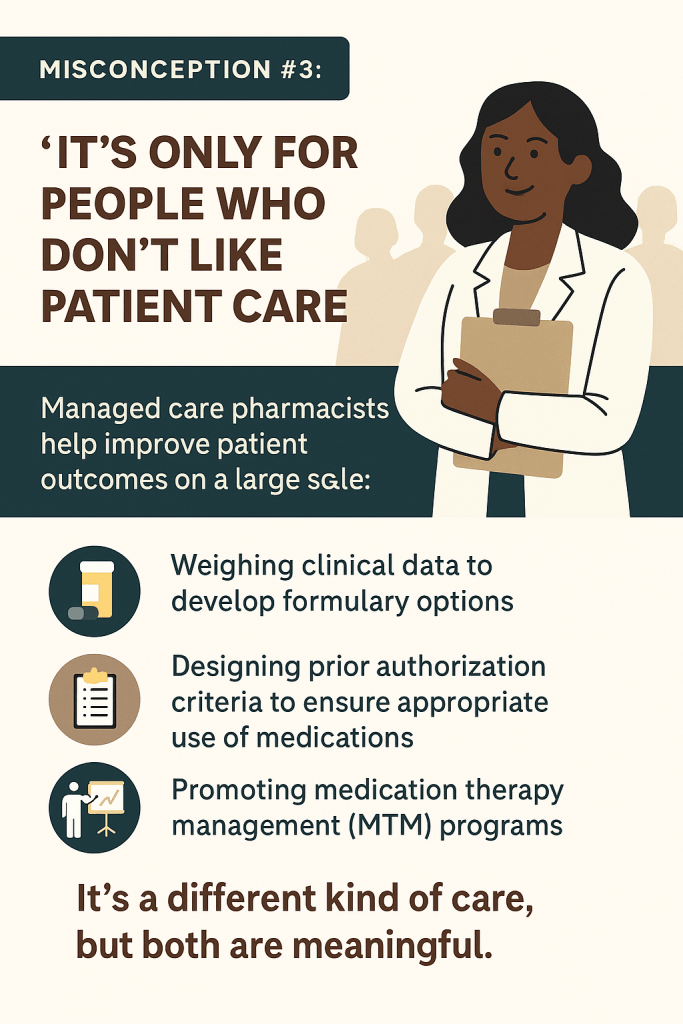
- A managed care pharmacist working on formulary development isn’t just picking the cheapest drugs – they’re carefully weighing clinical trial data, real-world outcomes, and clinical guidelines to ensure the most effective and appropriate options are prioritized.
- A managed care pharmacist who designs prior authorization criteria isn’t trying to block access to care – each criterion is crafted to ensure that high-cost, high-risk therapies are used appropriately and only when clinically justified.
- A managed care pharmacist promoting a medication therapy management (MTM) program isn’t just ticking administrative boxes – they’re building systems that directly improve patient outcomes by boosting medication adherence, optimizing therapies, and addressing clinical gaps, even without providing face-to-face care.
Managed care pharmacists absolutely care about patients. Instead of asking, “How can I help this one patient today?” they’re asking, “How can we help thousands of patients across our system get the safest, most effective, and most accessible treatments?”
It’s a different kind of care, but both are meaningful.
Closing (Part I)
As you can see, many of the common misconceptions about managed care pharmacy miss the bigger picture of what this field truly offers. Managed care pharmacists play a crucial role in shaping healthcare access, safety, and value at a system-wide level – work that’s both clinically rigorous and socially impactful.
But these aren’t the only misconceptions.
In Part II of this series, we’ll explore even more misunderstandings, including career growth opportunities and how managed care connects to patient care in powerful ways. Stay tuned. You won’t want to miss it!
 Managed Care Rx Insight